
Quick answer
Pick by the weather first, then safety, then whatever has waited longest.
Each week, ask three questions in order. Does this week's forecast call for something, like draining the outdoor faucets before a hard freeze or clearing the gutters before snow? Is a safety check due, like testing the smoke alarms or cleaning out the dryer's lint path? If neither, do the job that has gone the longest without attention.
Most weekly jobs take 15 to 45 minutes. One a week adds up to 52 a year, which is how you stay ahead of a house without handing it whole weekends. Anything that puts you on the roof, opens a gas line or an electrical panel, or chases a leak you can't trace isn't a weekly job: this week's job is booking the pro.
Why one job
A long list fails in a predictable way
Hand anyone a 40-item home checklist and they'll do the satisfying items first: wipe down the range hood, tighten a cabinet handle, feel productive. The outdoor faucet that needed draining before Monday's freeze waits for a weekend that never comes.
One job, picked for a reason, gets done. The reason matters as much as the job, because "clean the gutters" means something different the week before snow than it does in July. That's why the order below starts with the calendar outside your window, not the one on your fridge.
Decision path
The three questions, in order
Answer them top to bottom and stop at the first yes. That's this week's job.
Does this week's weather call for a job?
Look at the 7-day forecast for a first hard freeze, snow, a stretch of heat or several days of heavy rain. Weather jobs come with a deadline, so they go first.
Is a safety check due?
Smoke and carbon monoxide alarm tests, the dryer's lint path, space-heater clearance and anything that affects how everyone gets out in a fire.
What has waited longest?
Find the job with the longest gap since it was last done: the HVAC filter, the dishwasher filter, the water heater check, the caulk around the tub.
Does that job need a pro?
Roof work, gas appliances, electrical panels and leaks inside walls belong to a licensed pro, not a Saturday morning.
Seasoned homeowner tip: write down the date you finish each job, even on a sticky note inside a cabinet door. "What has waited longest?" is a two-second question when you have dates and a guessing game when you don't.
Season by season
Quick weekly jobs for each season
Use the first column when the forecast turns, the second to rotate safety checks in, and the third for quiet weeks. Shift outdoor jobs by a month or two for your climate; what matters is finishing weather work before the weather arrives.
| Season | When the forecast turns | Safety checks to rotate in | Quiet-week jobs |
|---|---|---|---|
| Fall Sept to Nov | Before the first hard freeze, disconnect and drain garden hoses and shut off the outdoor faucets. After the leaves drop, clear the gutters. Book heating service before the first cold week. | Test smoke and CO alarms. Before the first cold night, give each space heater 3 feet of clear space. | Replace the HVAC filter. Check that the dryer's outside vent flap opens and closes freely. Check weatherstripping on exterior doors. |
| Winter Dec to Feb | Before a hard freeze, open sink cabinets on exterior walls and keep the heat on if you travel. Before snow, keep the furnace and dryer vents outside clear, and get the shovel and ice melt ready. | Test smoke and CO alarms. Clean the dryer lint screen every load and check the vent hose behind the dryer. | Clean the dishwasher filter. Look under every sink for drips. Check the water heater for rust or water at its base. |
| Spring Mar to May | Before several days of heavy rain, pour a bucket of water into the sump pit to see the pump start, and make sure downspouts carry water away from the house. After the last freeze, reconnect the hoses. | Test smoke and CO alarms. Run the dryer and check that air comes out of the outside vent. | Clean window screens. Check the caulk around tubs and showers. Book air-conditioning service before the first hot week. |
| Summer Jun to Aug | Before a stretch of heat, replace the HVAC filter and clear plants, leaves and grass clippings from around the outdoor AC unit. | Test smoke and CO alarms. Clear lint from behind and under the dryer. | Clean the refrigerator coils if the manual calls for it. Check the irrigation heads. Look at the roof and gutters from the ground with binoculars. |
Want every month spelled out? The complete home maintenance schedule is the master list this table draws from, and the home winterization checklist covers everything to finish before the first hard freeze.
Safety checks
The checks that earn a spot every month
Smoke alarms
Press the test button on every alarm once a month, and replace 9-volt and hardwired alarms 10 years after the date printed on the back, according to USFA's smoke alarm guidance. Sealed 10-year alarms follow the manufacturer's replacement date.
Carbon monoxide alarms
Test them along with the smoke alarms. CPSC recommends CO alarms with battery power or battery backup on every level of the home and outside sleeping areas.
The dryer's lint path
CPSC's dryer fire guidance says to clean the lint screen before or after every load and to check, while the dryer runs, that air is coming out of the outside vent. If clothes take longer to dry than they used to, the vent or duct may be blocked.
Space heaters
Keep a space heater at least 3 feet from anything that can burn, including people, and plug it straight into a wall outlet, never an extension cord, per NFPA's space heater safety sheet.
For how many alarms and extinguishers your layout needs, see home fire safety: how many alarms and extinguishers do I need?
Three worked examples
How the questions play out in a real week
1. A hard freeze is coming Monday night
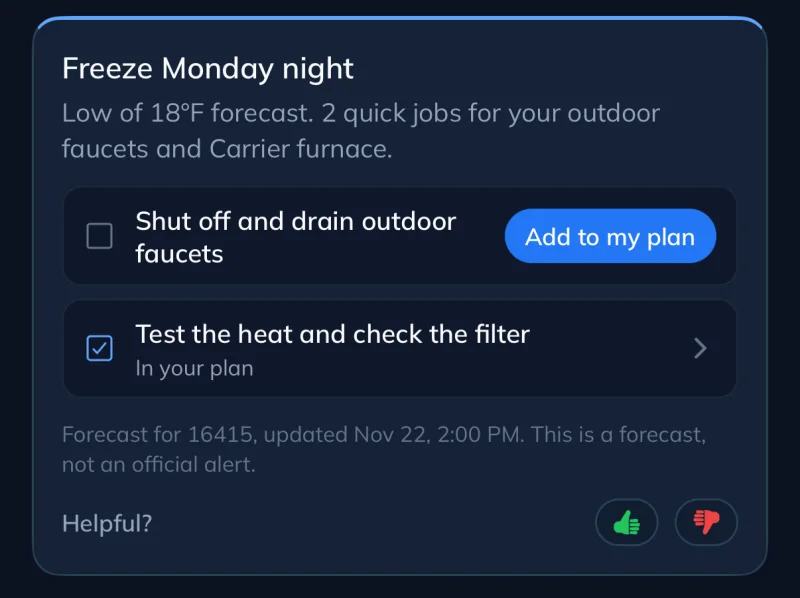
It's mid-November and the forecast shows a low of 18°F on Monday. Question one settles it: this week's job is shutting off and draining the outdoor faucets, with the hoses disconnected and stored. It takes 20 minutes. A hose left attached traps water in the outdoor faucet. When it freezes, the pipe can split behind the siding, and nobody notices until spring.
2. A mild week, and the alarms haven't been tested since summer
Early December, nothing unusual in the forecast. The last alarm test was in August, so question two wins: press the test button on every smoke and CO alarm, and check the date on the back of each one. An alarm that stays silent or is past its replacement date gets replaced this week, not added to a list.
3. A quiet week in late January
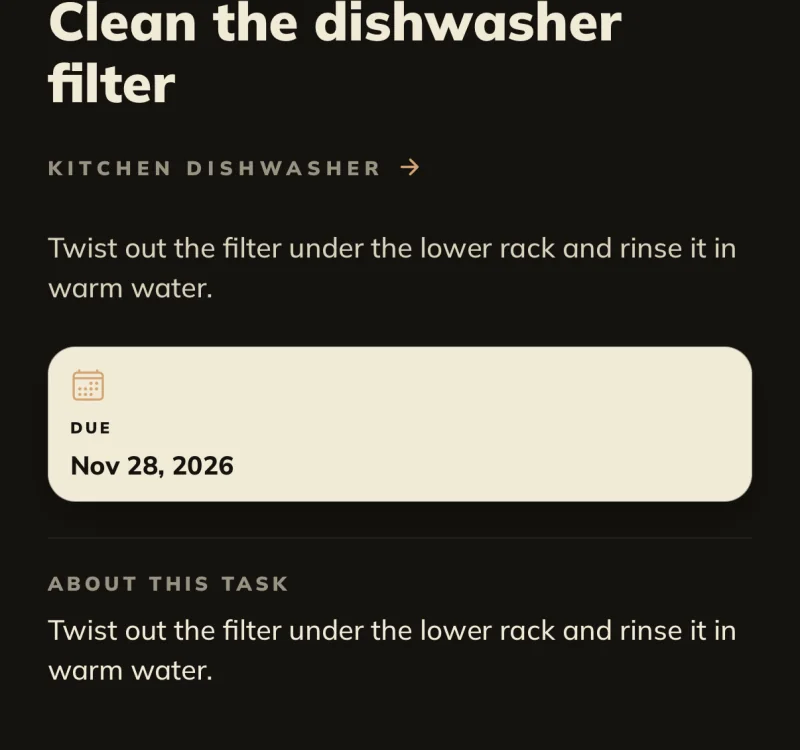
No weather job, and the alarms were tested two weeks ago. The job that has waited longest is the dishwasher filter, untouched since you moved in. Twist it out from under the lower rack, rinse it in warm water and put it back. Ten minutes, and the next load comes out cleaner.
When a generic list stops fitting
This week's job picks it for your home.
A season table can't see your forecast, how old your water heater is or the job you skipped in October. Homekeepr can. The top of My Home shows one job picked for this week, with the reason it's next, and you can mark it done right on the card. Anything you missed shows up as catch-up, not a red overdue date.
When a freeze, snow or heat is forecast at your address, the jobs to do first show up there too, and you can add them to your plan in one tap. Homekeepr is $50 a year.
Get Homekeepr for $50 a year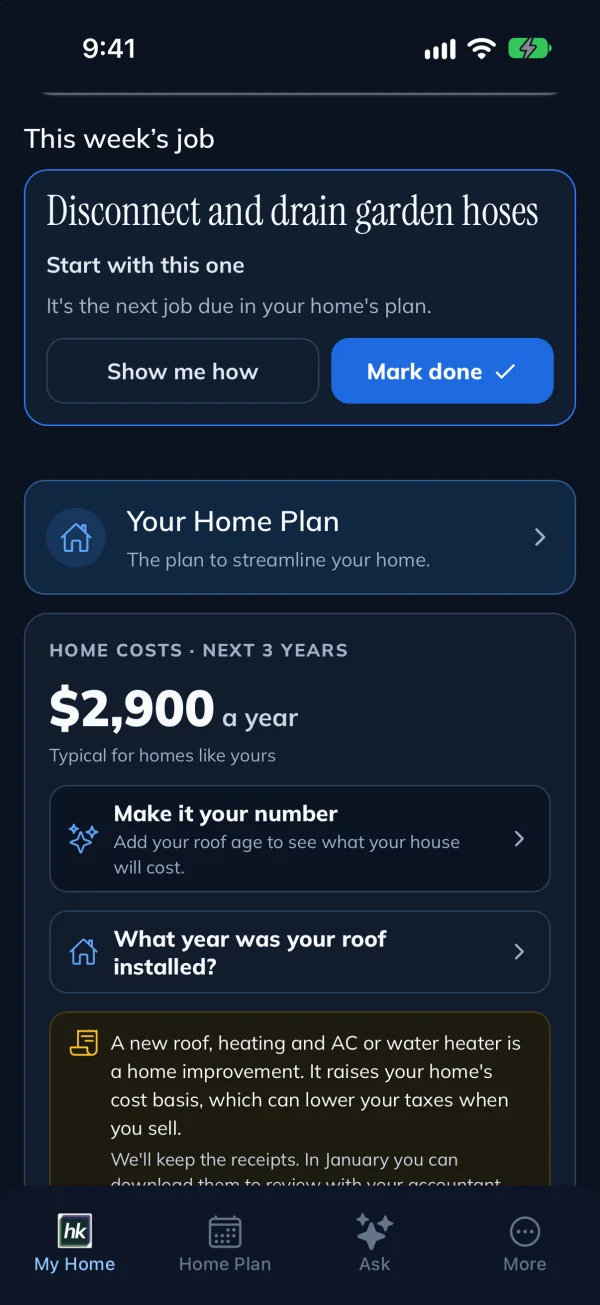
Weekly home maintenance FAQ
Questions about a one-job week
How much time should weekly home maintenance take?
Most weekly jobs take 15 to 45 minutes. If a job needs more than an hour, split it across two weeks or plan it as a weekend project.
What if a weather job and a safety check are both due?
Do the weather job first when the weather arrives before next week, then do the safety check the week after. If a safety check has already turned up a problem, like an alarm that fails its test, fix that right away.
Should I skip a week when nothing seems urgent?
No. A quiet week is the time for the job that has waited longest, like the dishwasher filter or a look at the water heater. Those are the jobs that cause trouble when they go years without attention.
Is a weekly job better than a monthly schedule?
They work together. A monthly or seasonal schedule tells you what's in season; the weekly pick turns it into one job you'll actually finish. Keep the full schedule as your master list and pull one job from it each week.
Sources and review status
Homekeepr Editorial checked the safety guidance above on the source pages on November 22, 2026. Season timing is general; shift outdoor jobs for your climate, and follow your equipment's manual where it differs.